Crisis of the Later Middle Ages:
è Black Death (1347): loss of 1/3 of European population (mostly in cities)
Causes: bubonic plague carried by fleas on Asian black rats; poor sanitation, overcrowded
homes, poor health, poor hygiene, poor housing
Results: Severe impact on European economy; in some areas workers enjoyed higher wages;
best of clergy died (staying behind to help the sick); Jews blamed; serfdom ended in many areas; first enclosure of fields in Britain
Population did not reach pre-plague level until the mid-16th century.
è Hundred Years’ War (1337-1453): cause—English lays claim to some French land
Joan of Arc: led French army to victory at Orleans during crucial stage of the war
Results: France kicks England out; creation of modern nation states begin (“New Monarchs”)
Peasant Revolts
Causes: taxation during Hundred Years’ War, desire for higher wages, hostility toward
aristocracy, and higher expectations among peasantry.
English Peasant Revolt (1381):
Jacquerie in France (late 14th-early 15th c.)
Results: revolts crushed; end of serfdom in England c. 1550
è Nationalist literature of the Later Middle Ages – use of the vernacular (national tongue)
Dante Alighieri (1265-1321), The Divine Comedy (1321) (also a Renaissance figure)
Geoffrey Chaucer (1340-1400): Canterbury Tales – portrayed English life
Francois Villon (1431-1463): Grand Testament (1461) – greatest poet of Medieval France
portrayed ordinary French life with humor and emotion.
è Crisis in the Catholic Church
Early Criticisms of the church
Marsiglio de Padua: Defender of Peace – Church should be subordinate to the state
Church should be governed by a council of laity and priests superior to pope.
John Wyclif (1320-1384): church should only follow Scripture; English
translation of Bible; his later followers were Lollards
John Huss (1369-1415): ideas similar to Wyclif; nationalist party in Czech (Bohemia)
Hussites: followers of Huss who staged large rebellions in 14th century.
Babylonian Captivity (1309-1377): 7 successive popes resided at Avignon, France
Damaged papal prestige (esp. in England & Germany); Rome’s economy damaged
Great Schism (c. 1377-1417): Further conflict led to election of two popes—one in Rome,
one in France; further hurt prestige of church
Conciliar Movement (1409-1418): ended schism; failed as movement to put power in a
church council; pope’s power still supreme
Life in Later Middle Ages
Marriage: avg. age for men = mid-20s; women = 16-18
divorce was unheard of
economic reasons most important for marriage (love not until 18th-19th centuries)
prostitution in cities (men didn’t marry until later)
Work:
agricultural cycles and church ritual closely linked
small % of men were artisans in towns; protected by guilds
Serfdom reduced in many areas
Recreation: aristocracy – jousting tournaments; common people—archery, wrestling, bull-
baiting, bear-baiting; alcoholism rampant
Laity increasingly managed parish lands
Fur-collar crime: corrupt nobles (esp. England) took advantage of peasantry
Medieval philosophy: scholasticism (St. Thomas Aquinas)
Attempted to reconcile faith and reason by using logic to support Christian doctrine
Worked to reconcile Aristotle’s ideas with Christianity
Sunday, March 9, 2008

Sunday, August 5, 2007
The Dawn of a New Era..
Well, the time has come for me to bid U.S. History goodbye for the time being and welcome AP European History into my life. Now in my own personal opinion I must admit U.S. History and I do not have the best relationship (whether it be because I'd rather live in Europe, or simplly because I'm an unpatriotic-country-hating-soon-to-be-arrested-by-the-FBI-and-CIA-heathen... or possibly both). The point is I've always been a more World History kind of gal, the type that likes to consider more of the world than simply one's own relatively insignificant country. Though European history isn't necessarily World history, it is one step closer and I have a feeling it will concern a much broader scope than the tax laws of Wisconsin in the 1900s. Of course it is more than likely that half-way through the year you will find me ranting and raving about how much I hate European History and the waste of time it is blah blah blah... the usual AP class workloaded panic. For now though, I can hope for the best and start the class with some eagerness. So it is time for me to bid adieu to "History Cram APUSH" and bring forth the new and improved "History Cram AP Euro". I'll still leave some APUSH links up for those who need to get their patriotic fix, but from now on this blog has a new focus. *cracks open a bottle of champagne* Au Revior mon amis!
Friday, April 20, 2007
Turn of the Century and WWI Terms
Laws related to US foreign Policy
Teller Amendment (1898)
• The Amendment promised that when the US overthrew Spanish rule in Cuba, the US would give Cubans their independence
• Later, the Platt Amendment would override the Teller Amendment as Cuba would come under US control after the Spanish-American War
Cuba and Platt Amendment (1901)
• Rider attached to Army appropriations bill
• It was written into the constitution of Cuba by the US and, in effect, made Cuba a US protectorate
• The US could intervene to preserve Cuba’s “independence”; in reality, the US could act to protect its own interests
• The US kept land for naval bases on Cuba; Guantanamo Bay would play a part in later Cuba-US conflicts
Hay-Pauceforte Treaty (1901)-
• British canceled treaty of 1850 allowing any canal in Central America to be under joint Brit-US control
• Allowed the US to dig the Panama Canal without British involvement
The Roosevelt Corollary to the Monroe Doctrine (1904)-
• Justified US intervention in Latin American countries when necessary
• US could send gunboats to Latin American country that was delinquent in paying its debts
• US sailors and marines occupy ports to manage collection of custom taxes until debt paid off
Root-Takahira Agreement (1908)-
• Sec. Of State Elihu Root & Japanese Ambassador Takahira pledged mutual respect for each nations Pacific possessions and support for Open Door policy in China
The Lodge Corollary-
• Stated that non-European powers would be excluded from owning territory in the Western Hemisphere
• Proposed by Henry Cabot Lodge who feared Japanese schemes to acquire land
• Opposed by Pres. Taft, offended Japan & Latin American Countries
The Progressive Era – Laws and Policies
Theodore Roosevelt’s Square Deal-
• President should do much more than lead executive departments
• President’s job to set legislative agenda for Congress
• Government will step in to settle disputes between labor and business
“Square Deal” for labor-
• Government intervention in disputes between labor and business
o 1902 Coal strike, mediated btw parties and threatened to take over mines if owners refused to compromise
Food and Drug Act (1906)-
• Forbade the manufacture, sale, and transportation of adulterated or mislabeled food & drugs
Meat Inspection Act (1906)-
• Placed strict controls on the meat industry‡The Secretary of Agriculture can inspect any meat for safety
• 4 requirements
o Inspection of livestock
o Post mortem for carcasses
o Sanitation
o Ongoing monitoring from the secretary of agriculture's dept
Payne-Aldrich Tariff(1909)-
• Proposed by Sereno Payne(R) and Nelson Alrich(R)
• Began as a bill that lowered tariffs but ended up raising tariffs though compromises
• Split the republican party into the true progressives and the Old Guard conservatives
Underwood Tariff (1913)-
• First federal income tax.
• Introduced the tax bracket system instead of fixed rates.
• Lowered tariffs, and income tax became the new source of income for the government
Wilson’s New Freedom (1913)-
• Wilson’s inaugural address pledged commitment to bring back conditions of free and fair competition in the economy
• Wilson attacked tariffs, banking, & trusts
Federal Reserve Act (1913)
• Response to the Panic of 1907 and concerns of business
• Need for a stable currency supply that could grow and shrink with business demands
• Several measures competed for designing this central reserve, ,each offering control to a different group
• President Wilson worked diligently to create and secure passage of act
• Divided the nation into separate regions with federal reserve banks in each that would serve as “banker’s banks”
• The Federal Reserve Board oversaw the system and regulated it by raising or lowering the interest rates that each federal reserve bank would charge
Clayton Antitrust Act (1914)-
• Further outlined regulations against monopolies and other unfair business practices
• Meant as update for the Sherman Antitrust Act of 1890
• Price discrimination that was destructive to competition was declared illegal
• Declared interlocking board of directors of direct competitors illegal
• Established Federal Trade Commission to investigate and prosecute instances of unfair competition
• Served as the grounds for many suits against big corporations
• Exempted labor unions engaged in legal activities
Federal Trade Commission (1914)-
• Regulatory agency that was allowed to investigate any "unfair trade practice" in every industry except for banking and transportation
• It was established to work against trusts
Federal Farm Loan Act (1916)-
• 12 regional farm loan banks were set up
• Farmers could put up to 50% of their land and 20% of their improvements as collateral
• Small farmers could improve their conditions and buy new equipment to challenge larger businesses with available capital
Keating-Owen Child Labor Act (1916)-
• Forbade shipment of products whose production had involved child labor
• Power of enforcement derived from interstate commerce, so the federal government could regulate it rather than states
• Declared unconstitutional because it interfered with the power of states
More important Laws
Sixteenth Amendment-
• Congress can collect an income tax for the spending of the federal government alone
Seventeenth Amendment (ratified 1913)-
• A progressive initiative that allowed for each state to elect 2 senators for 6-year terms by popular vote
• Restated the first paragraph of Article 1, Section 3 of the Constitution by replacing “chosen by Legislature thereof” with “elected by the people thereof”
• Allowed citizens to have a more active participation in the government
Eighteenth Amendment (1919)-
• Prohibition
• Made the creation, sale and transport of alcohol in the United States illegal and the state government has the ability to enforce this law with legislation
Nineteenth Amendment (1920)-
• 19th Amendment provided for women’s suffrage, which had been defeated earlier by the Senate
• Ratified by states 1920
• Feminists who supported suffrage since the 1860s included: Susan B. Anthony, Elizabeth Cady Stanton, and Carrie Chapman Catt
Espionage and Sedition Acts (1917 and 1918)-
• Fines and imprisonment for persons who made false statements which aided the enemy, hindered the draft, or incited military rebellion
• Forbade criticism of the government, flag, or uniform
• Led to imprisonment of major figures
• The Supreme Court upheld the acts, allowing the government to limit free speech when words represented clear and present danger, especially during times of war
Teller Amendment (1898)
• The Amendment promised that when the US overthrew Spanish rule in Cuba, the US would give Cubans their independence
• Later, the Platt Amendment would override the Teller Amendment as Cuba would come under US control after the Spanish-American War
Cuba and Platt Amendment (1901)
• Rider attached to Army appropriations bill
• It was written into the constitution of Cuba by the US and, in effect, made Cuba a US protectorate
• The US could intervene to preserve Cuba’s “independence”; in reality, the US could act to protect its own interests
• The US kept land for naval bases on Cuba; Guantanamo Bay would play a part in later Cuba-US conflicts
Hay-Pauceforte Treaty (1901)-
• British canceled treaty of 1850 allowing any canal in Central America to be under joint Brit-US control
• Allowed the US to dig the Panama Canal without British involvement
The Roosevelt Corollary to the Monroe Doctrine (1904)-
• Justified US intervention in Latin American countries when necessary
• US could send gunboats to Latin American country that was delinquent in paying its debts
• US sailors and marines occupy ports to manage collection of custom taxes until debt paid off
Root-Takahira Agreement (1908)-
• Sec. Of State Elihu Root & Japanese Ambassador Takahira pledged mutual respect for each nations Pacific possessions and support for Open Door policy in China
The Lodge Corollary-
• Stated that non-European powers would be excluded from owning territory in the Western Hemisphere
• Proposed by Henry Cabot Lodge who feared Japanese schemes to acquire land
• Opposed by Pres. Taft, offended Japan & Latin American Countries
The Progressive Era – Laws and Policies
Theodore Roosevelt’s Square Deal-
• President should do much more than lead executive departments
• President’s job to set legislative agenda for Congress
• Government will step in to settle disputes between labor and business
“Square Deal” for labor-
• Government intervention in disputes between labor and business
o 1902 Coal strike, mediated btw parties and threatened to take over mines if owners refused to compromise
Food and Drug Act (1906)-
• Forbade the manufacture, sale, and transportation of adulterated or mislabeled food & drugs
Meat Inspection Act (1906)-
• Placed strict controls on the meat industry‡The Secretary of Agriculture can inspect any meat for safety
• 4 requirements
o Inspection of livestock
o Post mortem for carcasses
o Sanitation
o Ongoing monitoring from the secretary of agriculture's dept
Payne-Aldrich Tariff(1909)-
• Proposed by Sereno Payne(R) and Nelson Alrich(R)
• Began as a bill that lowered tariffs but ended up raising tariffs though compromises
• Split the republican party into the true progressives and the Old Guard conservatives
Underwood Tariff (1913)-
• First federal income tax.
• Introduced the tax bracket system instead of fixed rates.
• Lowered tariffs, and income tax became the new source of income for the government
Wilson’s New Freedom (1913)-
• Wilson’s inaugural address pledged commitment to bring back conditions of free and fair competition in the economy
• Wilson attacked tariffs, banking, & trusts
Federal Reserve Act (1913)
• Response to the Panic of 1907 and concerns of business
• Need for a stable currency supply that could grow and shrink with business demands
• Several measures competed for designing this central reserve, ,each offering control to a different group
• President Wilson worked diligently to create and secure passage of act
• Divided the nation into separate regions with federal reserve banks in each that would serve as “banker’s banks”
• The Federal Reserve Board oversaw the system and regulated it by raising or lowering the interest rates that each federal reserve bank would charge
Clayton Antitrust Act (1914)-
• Further outlined regulations against monopolies and other unfair business practices
• Meant as update for the Sherman Antitrust Act of 1890
• Price discrimination that was destructive to competition was declared illegal
• Declared interlocking board of directors of direct competitors illegal
• Established Federal Trade Commission to investigate and prosecute instances of unfair competition
• Served as the grounds for many suits against big corporations
• Exempted labor unions engaged in legal activities
Federal Trade Commission (1914)-
• Regulatory agency that was allowed to investigate any "unfair trade practice" in every industry except for banking and transportation
• It was established to work against trusts
Federal Farm Loan Act (1916)-
• 12 regional farm loan banks were set up
• Farmers could put up to 50% of their land and 20% of their improvements as collateral
• Small farmers could improve their conditions and buy new equipment to challenge larger businesses with available capital
Keating-Owen Child Labor Act (1916)-
• Forbade shipment of products whose production had involved child labor
• Power of enforcement derived from interstate commerce, so the federal government could regulate it rather than states
• Declared unconstitutional because it interfered with the power of states
More important Laws
Sixteenth Amendment-
• Congress can collect an income tax for the spending of the federal government alone
Seventeenth Amendment (ratified 1913)-
• A progressive initiative that allowed for each state to elect 2 senators for 6-year terms by popular vote
• Restated the first paragraph of Article 1, Section 3 of the Constitution by replacing “chosen by Legislature thereof” with “elected by the people thereof”
• Allowed citizens to have a more active participation in the government
Eighteenth Amendment (1919)-
• Prohibition
• Made the creation, sale and transport of alcohol in the United States illegal and the state government has the ability to enforce this law with legislation
Nineteenth Amendment (1920)-
• 19th Amendment provided for women’s suffrage, which had been defeated earlier by the Senate
• Ratified by states 1920
• Feminists who supported suffrage since the 1860s included: Susan B. Anthony, Elizabeth Cady Stanton, and Carrie Chapman Catt
Espionage and Sedition Acts (1917 and 1918)-
• Fines and imprisonment for persons who made false statements which aided the enemy, hindered the draft, or incited military rebellion
• Forbade criticism of the government, flag, or uniform
• Led to imprisonment of major figures
• The Supreme Court upheld the acts, allowing the government to limit free speech when words represented clear and present danger, especially during times of war
Thursday, April 19, 2007
Chapter 22 - Jake 3 minute REVIEW notes
This isn't meant to replace the textbook. Only for quick review purpose.
Notes – Battle for National Reform
Guiding questions
How did the nature of the executive power change with Roosevelt’s Presidency?
Why did the presidents at this time attack the trusts so much?
Why did the United States turn militaristic against the foreign nations at this time?
Notes
I. Theodore Roosevelt and the Modern Presidency
1. The Accidental President
a. McKinley dies in 1901 à Roosevelt becomes the president after him.
b. A rancher in the Dakota badlands à commander of the Rough Riders (hence the stereotype)
2. Government, Capital, and Labor
a. Viewed the federal power as the mediator of the public good à mediator for labor.
b. Not completely against the trusts, but dissolved Northern Securities Company of J.P Morgan.
3. “The Square Deal”
a. At first, concerned with re-election à wins the election of 1904 for second term
b. Square Deal for everyone à Hepburn Act: Control of the Railroads. Pure Food and Drug Act
4. Roosevelt and Conservation and Preservation
a. Concerned with the environment and natural resources à national parks ↑
b. New Lands Act: Federal aid to fund dams, reservations, and canals in the west.
c. Naturalist ideals + Pragmatic Conservationist (conservation to further make use of resources)
d. Hetch Hetchy Controversy – Roosevelt ↑ the dam building in San Francisco: practicality↑↑
5. The Panic of -1907
a. Overproduction from industry à Speculation↑ à Crash à Conservatives blame Roosevelt à J.P Morgan lends gold for letting US Steel absorb Tennessee Coal and Iron Company
II. The Troubled Succession
1. Taft and the Progressives: failed attempts at lowering tariffs
a. William Howard Taft à Payne-Aldrich Tariff: no effect in lowering tariffs at all
b. Moderate with reformation: Ballinger-Pinchot Dispute over forest/mineral reserves
à Alienated Roosevelt supporters by kicking Pinchot out
2. The Return of Roosevelt
a. Roosevelt returns to politics à New Nationalism: powerful federal government
b. Taft kills Tennessee Coal and Iron Company/US Steel of Morgan for antitrust.
c. Republican party nominates Taft à Roosevelt forms the Progressive Party.
III. Woodrow Wilson and the New Freedom
1. Woodrow Wilson
a. New Freedom: anti-monopoly↑. Wilson wins the election of 1912 against Taft and Roosevelt
b. Executive powers↑, Tariff↓ Federal Reserve Act: 12 regional Federal Reserve Banks + Federal Reserve Notes used with Government backing the currency
c. Monopoly à Regulatory Commission to bust the trusts à Legal attacks on monopoly↑
2. Retreat and Advance
a. Women’s suffrage ↓ by Wilson at first, segregation ↑↑ in south.
b. Wilson loses some progressive support à then supports reforms and passes child labor laws
IV. The “Big Stick”: America and the World, 1901~1917
1. The Iron-fisted neighbor
a. Roosevelt distinguished the civilized nation as industrial powers
b. Roosevelt wins the Nobel Peace Prize for ending Russo-Japanese War: Open door↑↑↑
c. Roosevelt Corollary + Monroe Doctrine: US right to intervene to domestic issues in Latin Am.
d. Taft: Dollar Diplomacy – invest in Latin America à dominate their economy
e. Moral Diplomacy: Intervened in Mexican Revolution to kill Pancho Villaà attacked Veracruz
Notes – Battle for National Reform
Guiding questions
How did the nature of the executive power change with Roosevelt’s Presidency?
Why did the presidents at this time attack the trusts so much?
Why did the United States turn militaristic against the foreign nations at this time?
Notes
I. Theodore Roosevelt and the Modern Presidency
1. The Accidental President
a. McKinley dies in 1901 à Roosevelt becomes the president after him.
b. A rancher in the Dakota badlands à commander of the Rough Riders (hence the stereotype)
2. Government, Capital, and Labor
a. Viewed the federal power as the mediator of the public good à mediator for labor.
b. Not completely against the trusts, but dissolved Northern Securities Company of J.P Morgan.
3. “The Square Deal”
a. At first, concerned with re-election à wins the election of 1904 for second term
b. Square Deal for everyone à Hepburn Act: Control of the Railroads. Pure Food and Drug Act
4. Roosevelt and Conservation and Preservation
a. Concerned with the environment and natural resources à national parks ↑
b. New Lands Act: Federal aid to fund dams, reservations, and canals in the west.
c. Naturalist ideals + Pragmatic Conservationist (conservation to further make use of resources)
d. Hetch Hetchy Controversy – Roosevelt ↑ the dam building in San Francisco: practicality↑↑
5. The Panic of -1907
a. Overproduction from industry à Speculation↑ à Crash à Conservatives blame Roosevelt à J.P Morgan lends gold for letting US Steel absorb Tennessee Coal and Iron Company
II. The Troubled Succession
1. Taft and the Progressives: failed attempts at lowering tariffs
a. William Howard Taft à Payne-Aldrich Tariff: no effect in lowering tariffs at all
b. Moderate with reformation: Ballinger-Pinchot Dispute over forest/mineral reserves
à Alienated Roosevelt supporters by kicking Pinchot out
2. The Return of Roosevelt
a. Roosevelt returns to politics à New Nationalism: powerful federal government
b. Taft kills Tennessee Coal and Iron Company/US Steel of Morgan for antitrust.
c. Republican party nominates Taft à Roosevelt forms the Progressive Party.
III. Woodrow Wilson and the New Freedom
1. Woodrow Wilson
a. New Freedom: anti-monopoly↑. Wilson wins the election of 1912 against Taft and Roosevelt
b. Executive powers↑, Tariff↓ Federal Reserve Act: 12 regional Federal Reserve Banks + Federal Reserve Notes used with Government backing the currency
c. Monopoly à Regulatory Commission to bust the trusts à Legal attacks on monopoly↑
2. Retreat and Advance
a. Women’s suffrage ↓ by Wilson at first, segregation ↑↑ in south.
b. Wilson loses some progressive support à then supports reforms and passes child labor laws
IV. The “Big Stick”: America and the World, 1901~1917
1. The Iron-fisted neighbor
a. Roosevelt distinguished the civilized nation as industrial powers
b. Roosevelt wins the Nobel Peace Prize for ending Russo-Japanese War: Open door↑↑↑
c. Roosevelt Corollary + Monroe Doctrine: US right to intervene to domestic issues in Latin Am.
d. Taft: Dollar Diplomacy – invest in Latin America à dominate their economy
e. Moral Diplomacy: Intervened in Mexican Revolution to kill Pancho Villaà attacked Veracruz
Monday, April 16, 2007
Chapter 23: America and the Great War
I. The Road to War
A. The Collapse of the European Peace
A. Entering the War
∑ Financing the War - $32 billion appropriated by gov for expenses directly related to the conflict
A. The Peace Movement
A. The Fourteen Points
A. The Collapse of the European Peace
- Competing Alliances
- “Triple Entente” (Britain, France, Russia) vs. “Triple Alliance” (Germany, Austria-Hungry, Italy)
- Underlying struggle btw Britain & Germany
- June 28 1914, assassination of Archduke Franz Ferdinand by Serbian nationalist in Sarajevo, Bosnia
- In less than year, entire Euro continent & part of Asia in War
- Wilson -> “remain impartial in thought as well as deed”
- German & Irish Americans --> support German cause, Wilson & many --> support for Britain
- Economic Ties to Britain
- Brits imposed naval blockade on Germany, US continued to trade with Brits (not truly neutral)
- Ally war demands --> economic Boom in U.S.
- 1915 U.S. gone from neutral power --> arsenal of allies
- Lusitania – British passenger liner, also carrying munitions, that was sunk by German submarine and resulted in the death of 128 Americans
- Wilson demanded Germany not repeat attacks and recognize Americans neutrality & and ability to safely travel in belligerent waters
- 1916 Brits arm merchant vessels to compete against German submarines --> Germany declares would fire on such vessels w/o warning
- Germans sink unarmed French Sussex (killing American passengers) --> Wilson demands an end to “unlawful” tactics --> Germans agree
- Germans relented b/c marginally effective tactics not worth drawing Americans into war
- Wilson battling for reelection needed to acknowledge factions opposing intervention
- --> Policies attempted to balance demands of defending national honor & economic interests against demands of taking no action that would increase chance of war
- 1915 Wilson endorsed ambitious proposal for large & rapid increase in armed forces
- 1916 Democratic convention --> “He kept us out of war”
- 1916 Election – Wilson narrowly beats Hughes
- Jan 1917, speech before congress, Wilson created own rational behind going to war
- U.S. had no material aims
- Committed to using war as vehicle for constructing new world order based on progressive ideals that motivated American reform
- Peace through permanent league of nations
- Provocation for War
- German policy --> assaults on enemy lines in France with unrestricted submarine warfare (allied & amer. Ships) to cut off Brit supplies
- Zimmermann Telegram – Feb 25th, intercepted telegram from German foreign minister Arthur Zimmermann to Mex government
- In case of war Mexicans should side with Germans against Americans
- Would regain lost provinces
- March 1917 – collapse of Czarist Russia
- U.S. would not be allied with monarchy
- April 2nd – Wilson asks Congress for Declaration of war
- Protect democracy & rights and liberties of small nations
- April 6 Congress passes Declaration of war
A. Entering the War
- When U.S. entered, Europe in stalemate
- Most immediate effect on sea conflict
- Destroyers aided assault on U-Boats
- Warships escorted merchant vessels
- Submarine mines in North Sea
- Russian Revolution --> Russia withdraws from war, treaty with Germany giving up land and freeing up western troops
- --> American ground troops necessary
- U.S. had few and inexperienced soldiers
- Selective Service Act – national draft
- American Expeditionary Force (AEF) - 3 million from draft, 2 million into army services voluntarily
- Most diverse fighting force US had ever assembled
- Women allowed to enlist --> roles in hospitals and offices
- 400,000 black soldiers – segregated units w/ white commanding officer
- General John J. Pershing – commanded AEF as it joined Allied forces
- Chåteau-Thierry - June 1918, American forces helped repel German attack that brought Germans 50 miles from Paris
- July 18 Allies halted German advance and began own offense
- Meuse-Argonne Offensive – Sept 26 1918, American fighting force began 7 week attack that helped push Germans back towards own border & cut major supply lines
- Germans faced with invasion of own country --> sought armistice to prelude negotiations
- November 11, 1918 Great War ended
- Machine guns & high-powered artillery --> development of trench warfare
- Development of tanks, flamethrowers, chemical weapons allowed forces to attack entrenched soldiers without direct combat
- --> Need for elaborate maintenance and supplies
- Airplanes played significant role – bombers, fighters, reconnaissance
- New naval battleships – turbine propulsion, hydraulic gun controls, electric light & power, wireless telegraphy, navigation aids
- New technologies --> High Casualty Rates
- Mobilizing industrial economy for total war required great government involvement in industry, agriculture, and other areas
- Required strenuous effort to ensure loyalty & commitment of people
∑ Financing the War - $32 billion appropriated by gov for expenses directly related to the conflict
- 1) “Liberty Bonds” – gov’s attempted to solicit loans from American people
- 1920 - $23 billion
- 2) New taxes – excess corporation profits, steeply graduated income & inheritance taxes
- $10 billion
- Organizing the Economy
- 1) Wilson established Council of National Defense (1916) – set up local defense councils in every state, econ mobilization rested on large-scale dispersal of power to local communities
- Proved completely unworkable
- Council members (influenced by engineering gospel and “scientific management”) urged more centralized approach
- Divide power through several planning bodies supervising a specific sector of the econ
- 2) War Industries Board (1917) – coordinated government purchases of military supplies
- Restructured in 1918 and put under control of Bernard Baruch
- Baruch appeared to provide centralized regulation of economy
- WIB, in fact, plagued by mismanagement and inefficiency
- American resources and productive capacities > WIB
- Government was working to enhance private sector through mutually beneficial alliance
- Lessons of the Managed Economy
- Spectacular accomplishments (organization of domestic food supplies and railroads)
- Leaders of gov and industry convinced of a close, cooperative relationship btw the public and private sectors
- Hoped to continue wartime experiment in peacetime
- The National War Labor Board (April 1918) – resolve labor disputes & pressured industry to grant important concessions to workers
- 8 hr work day
- Maintenance of minimal living standards
- Equal pay for women doing equal work
- Recognition of the right of unions to organize and bargain collectively
- Insisted workers forgo strikes and employers not engage in lockouts
- War provided workers w/ important temporary gains but did not stop labor militancy
- Ludlow Massacre (1914) - Western Federation of Minders struck against Rockefeller coal mines --> strikebreakers & militia attacked workers’ tent colony --> 39 dead
- War --> Boom, began 1914 b/c of Euro demands, accelerated 1917 from US demands
- “Great Migration” – migration of many African Americans from rural south into northern industrial cities
- Push – poverty, indebtedness, racism, violence
- Pull – prospect of factory jobs in urban North, opportunity to live in communities where blacks could enjoy more freedom & autonomy
- Increase in black communities --> race riots
- War = new opportunities for women
- Worked in wide range of industrial jobs left behind by men
- After war women either fired or quit these jobs
- Women in Industry Board – formed to oversee movement of women into jobs left behind by men in military, remained even after war --> Women’s Bureau – permanent agency dedicated to protecting interest of women in the work force
A. The Peace Movement
- Pre 1917: German Americans, Irish Americans, religious pacifists, intellectuals, Socialist Party, Industrial Workers of the world
- War = meaningless battle among capitalist nations for commercial supremacy
- Women’s Peace Party (1915) – developed by Carrie Chapman Catt, efforts to keep US from intervening in war
- Post 1917 – National American Woman Suffrage Association supported war and presented itself as patriotic organization, Catt abandoned peace cause --> called for woman suffrage as war measure
- Jane Addams, Charlotte Perkins Gilman, and others still opposed war
- Maternal Opposition to War – moral and maternal basis for pacifism
- War --> boost to religious revivalism --> support for war
- Committee on Public Information (CPI) – directed by George Creel, supervised distribution of pro-war literature
- Urged “self censorship” in news
- At first presented facts --? anti German propaganda (The Kaiser: Beast of Berlin) --> encouraged Americans to think of Germans as savages
- Espionage Act of 1917 – stiff penalties for spying, sabotage, obstruction of war effort; empowered post office to ban seditious material from mails
- Sabotage Act & Sedition Act (1918) - any public expression of opposition to the war = illegal; officials could persecute anyone who criticized pres or gov
- Acts targeted anti-capitalist groups (Socialist party & IWW)
- Repressing Dissent
- American Protective League – group whose members served as “agents” discovering dissenting individuals
- National Security League, Boy Spies of America, American Defense Society
- “100 Percent Americanism”
- Anti-German measures
A. The Fourteen Points
- Jan 8, 1918 Wilson presented principles nation was fighting for --> fourteen points
- 8 recommendations for adjusting postwar boundaries & for establishing new nations
- right of all peoples to self-determination
- 5 general principles to govern international conduct in future
- freedom of the seas
- open covenants (no secret treaties)
- reductions in armaments
- free trade
- impartial mediation of colonial claims
- League of nations
- Flaws
- No formula for deciding how to apply “self-determination”
- Little about economic rivalries and their effect on international relations
- Lenin’s Challenge
- Dec 1917 Lenin issued own war aims (very similar to Wilson’s)
- Wilson’s last minute attempt to keep Russia in war
- Wilson realized Lenin = competitor in postwar order
- Allied leaders resented U.S.’s tone of moral superiority and separation from Allied forces
- Allied Intransigence – Britain and France wanted compensation and revenge against Germany
- Wilson against the Republican party
- The Big 4 – Lloyd George (Britain), Clemenceau (France), Vittorio Orlando (Italy), Wilson (US)
- Idealism competing with national aggrandizement
- Wilson indirectly helped White Russian forces against Bolsheviks, and refused to recognize new government until 1933
- Wilson’s Retreat – economic & strategic demands constantly in conflict with principle of cultural nationalism
- Reparations
- Wilson initially opposed demanding compensation, but eventually accepted principle of reparations
- 1921 --> $56 Billion, 1930s --> became $9 million
- crippled already weak economy
- Successes
- Imperial possessions in “trusteeship” under League of Nations
- Blocked French proposal to break up Western Germany
- League of Nations - jan 25 1919
- Wilson presented Treat of Versailles to senate on July 1919 --> Wilson’s Intransigence
- Henry Cabot Lodge – powerful chairman of Foreign Relations Committee who hated the president and used very possible tactic to obstruct delay and amend the treaty
- Wilson’s intransigence --> Senate would not budge --> appeal to the public
- While on tour to arouse public support Wilson reached end of strength --> stroke --> impaired function and increased intransigence
- League Membership Rejected
- Public interest in peace process fading b/c of ratification fight & other crises
- New Social Environment –
- post 1918 no longer receptive to progressive reform
- severe post war economic recession
- War ended sooner than anticipated --> nation needed to establish economic reconversion
- 1920 – disastrous inflation that killed market for consumer goods
- Postwar Recession
- Loss of jobs
- Inflation wiped out modest wage gains
- Employers rescinded benefits they had conceded in 1917-1918 --> strikes
- Boston Police Strike – response to layoffs and wage cuts
- Without police Boston --> violence & looting
- Governor Calvin Coolidge called in National Guard --> officials dismissed entire police force & hired new one
- Steelworkers Strike (Sept 1919) – eastern & Midwestern steelworkers walked off job demanding 8 hr work day & union recognition
- Long, bitter, violent strike --> Riot in Gary, Indiana --> steel mill continued working with nonunion labor & public dissent --> Steelworkers’ Strike Defeated
- New Black Attitudes
- Accentuated African American bitterness
- Increased determination to fight for rights
- Chicago Race Riots (1919)
- Black teenager swimming in Lake Michigan stoned by whites and drowned
- Angry blacks retaliated in white neighborhoods
- Larger white crowds attacked black neighborhoods
- NAACP urged blacks to demand government protection AND fight back & defend themselves
- Marcus Garvey’s Black Nationalism
- Garvey encouraged African Americans to take pride in own achievements & develop awareness of heritage
- Reject assimilation into white society
- Pride in own superior race and culture
- United Negro Improvement Association (UNIA) – pressed for creation of black businesses
- Leave America and return to Africa
- Russian Revolution 1917 --> communism no long theory = important regime
- Formation of Communist International (Comintern) – export revolution around the world
- American Communist Party 1919
- Bombings --> Popular Antiradicalism
- “100 Percent Americanism” --> Red Scare
- Palmer Raids – Jan 1 1920, Attorney General A. Mitchell Palmer & J. Edgar Hoover orchestrated raids on alleged radical centers & made many arrests
- Did not fight huge caches of weapons and explosives
- Most of arrested released
- Sacco and Vanzetti (1920) – 2 Italian immigrants charged with murder of paymaster in Massachusetts
- Convicted and sentenced to death under bigoted trail and injudicious circumstances
- Supported for Sacco and Vanzetti increased but calls for retrial rejected
- Aug 23, 1927 executed among international protest
- 19th Amendment – Aug 26, 1920 – guaranteed women the right to vote
- --> passage of Shepard Towner Maternity and Infancy Act 1921 – provided funds for supporting the health of women and infants
- 1922 Cable Act – granted women the rights of US citizenship independent of their husbands’ status
- Election of 120
- Republican Warren Gamaliel Harding offered no ideals only vague promise of return to “Normalcy”
- Landslide victory --> new era
Saturday, April 14, 2007
Chapter 21: The Rise of Progressivism
I. The Progressive Impulse
- Belief in Progress --> society capable of improvement & continued growth and advancement = nations destiny
- Direct intervention in social and econ = essential for order and improved society
- “Antimonopoly” – fear of concentrated power and urge to limit/disperse authority & wealth
- appealed to workers, farmers, and some middle class
- helped empower gov to regulate or break up trusts (state & national)
- Social Cohesion – belief that individuals are not autonomous, part of web of social relationships --> welfare of individual dependent on welfare of whole society
- Concern w/ “victims” of industrialization --> initiatives & reforms attempting to help women, children, industrial workers, immigrants, African Americans (less)
- Faith in Knowledge – possibilities of applying principles of natural & social science to society --> organization & efficiency
- Social order = result of intelligent social organization & rational procedures
- Knowledge = vehicle for equitable humane society
- Modernized gov must play important role in process of stabilizing society
- Need for new enhanced institutions of gov, leaders, experts
- Muckrakers – crusading journalists directing public attention to social, econ, and political injustices (Theodore Roosevelt --> “raking up muck”)
- At first major targets = trusts & railroads --> dangerously powerful, deeply corrupt
- 1860s Charles Francis Adams Jr uncovered corruption among railroad barons
- Ida Tarbell & Lincoln Steffens
- 1904 published study of Standard Oil trust by Ida Tarbell
- turn of cen --> muckrakers focus on gov (political machines)
- Lincoln Steffens – reporter for McClure’s magazine who exposed machine gov and boss rule
- Tone of studied moral outrage --> aroused sentiment for urban political reform
- The Shame of the Cities
- Muckrakers peak influence1900-1910
- Investigated govs, labor unions, corporations
- Explored problems of child labor, immigrant ghettoes, prostitution, family disorganization
- Denounced waste & destruction of natural resources, subjugation of women, oppression of blacks (on occasion)
- Helped inspire Americans to take action
- Expressed basic progressive impulses
- Opposition to monopoly
- Belief in need for social unity among corruption & injustice
- Efficiency & organization
- Public outrage at injustice + social responsibility --> reformers committed to social justice
- “Social Gospel”(early 20th cen) – powerful movement w/I American Protestantism concerned w/ redeeming nation’s cities
- Salvation Army = fusion of religion & reform, Christian social welfare org offering material aid & spiritual service to urban poor
- Many ministers, priests and rabbis left traditional parish work to serve in troubled cities
- In His Steps (1898) Charles Sheldon --> most successful novel of era
- Walter Rauschenbusch – Protestant theologian who published influential discourses on possibilities for human salvation through Christian reform
- Message of Darwinism = cooperation to ensure humanitarian evolution
- Father John Ryan
- Rerum Novarum (1893 publication of Pope Leo XIII) --> rich were relying on poor almost like slaves
- Worked to expand scope of Catholic welfare organizations
- Social Gospel was never dominant element in movement for urban reform --> dismissed as irrelevant moralization
- Brought progressive movement powerful moral component & commitment
Monday, April 9, 2007
Chapter 20 - Section Three - The Imperial Republic
1. What is imperialism? What are the goals of imperialistic countries? Provide several examples of 19th century European imperialism and examples of how the United States engaged in imperialism.
 4. Who was Queen Liliuokalani?
Bush may have CHEATED to win 2004 Election: Faulty Voting Machines or True Victory?!
8. Create a chart that shows how the following people were involved in the Spanish-American War; Jose Marti, Valeriano Weyler, Grover Cleveland, William McKinley, Dupuy de Lome, George Dewey, Theodore Roosevelt.
 9. What happened at San Juan Hill?

12. What were the arguments of the Anti-Imperialist League?
• Closed:
16. Who was John Hays and what did he write in his notes?
• John Hays: Secretary of State
• Translated McKinley “Open door statement” into policy --> “Open Door Notes”
• “Open Door Notes”: addressed identical messages to England, Germany, Russia, France, Japan, and Italy --> asked them to approved 3 principles
1) each nation w/ a sphere of influence in China was to respect the rights and
privileges of other nations in its sphere
2) Chinese officials were to continue to collect tariff duties in all spheres
3) nations were not to discriminate against other nations in levying port dues and
railroad rates w/in their own spheres
Would allow US to trade freely w/ Chinese w/out fear of interference and w/o having to become militarily involved in region
17. Who were the Boxers and why did they rebel?
• Boxers = a secret nationalist Chinese martial-arts society whose nationalist conviction lead them to rebel against foreigners
18. How did the Boxer Rebellion affect China - U.S. A. relations?
• Chinese territorial integrity survived at least in name
• US maintained access to trade
19. Explain (your opinion - based on facts) the significant ways that imperialism changed the United States as it entered the 20th century. Think about social, political, military, and economic considerations.
- Imperialism: territorial acquisition to extend a nations power
- Ex. Imperial Britain (largest), France, Germany, Portugal, other European countries establishing colonies in Asia and Africa
- U.S. engaged in imperialism after it acquired land from the Spanish-American war (1898)
- Alfred Thayer Mahan published his thesis in The Influence of Sea Power Upon History
- Countries with sea power were great nations in history
- Prerequisites for naval power = productive domestic econ, foreign commerce, strong merchant marine, navy to defend trade routes, colonies
- Advocated US construct a canal across Central America
- 1870s and 1880s gov launched shipbuilding program
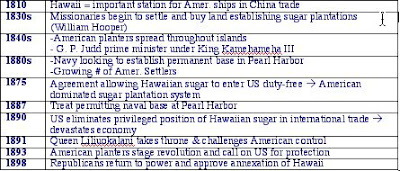
 4. Who was Queen Liliuokalani?
- Queen Liliuokalani: strong nationalist who took the throne in 1891 and set out to challenge the growing American control of the islands
- Only on throne for 2 yrs, 1890 US eliminated privileged position of Hawaiian sugar in international trade
- Only way for islands to recover was to become part of U.S.
- The destruction of the Maine was seen as an attack from Spain
- Spanish minister insulted the President
- The US was able to take the US holding of Puerto Rico and the Philippines and fain favor with Cuba
- Joseph Pulitzer – Hungarian immigrant, Civ War vet, successful newspaper publisher in St. Louis --> bought NY World 1883‡ very successful
- ^ “Yellow Journalism” new tech possibilities, came to mean sensationalist style or reporting and writing
- William Randolph Hearst imitator who bought New York Journal 1895
- Used color even more lavishly than Pulitzer
- Competition btw the two
- Sensationalized coverage of the Maine and Spanish American War
Bush may have CHEATED to win 2004 Election: Faulty Voting Machines or True Victory?!
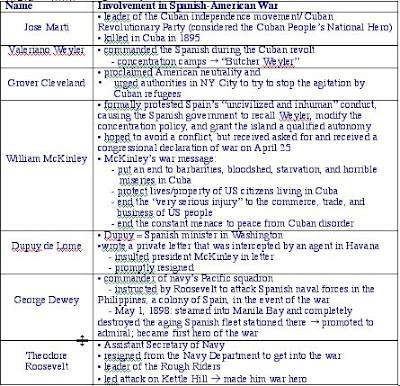
8. Create a chart that shows how the following people were involved in the Spanish-American War; Jose Marti, Valeriano Weyler, Grover Cleveland, William McKinley, Dupuy de Lome, George Dewey, Theodore Roosevelt.
 9. What happened at San Juan Hill?
- Theodore Roosevelt charged San Juan Hill --> took control of important location near Santiago
- Earned Roosevelt his reputation
- Calvary unit led by Theodore Roosevelt --> made him into hero

12. What were the arguments of the Anti-Imperialist League?
- Imperialism = immoral
- Opposed concept of American freedom
- Dislike of inferior races
- Feared large standing armies
- Dislike competition
- U.S. controlled military and occupied country
- Supported the infrastructure schools, hospitals, roads, administration
- Platt Amendment meant the Cuban Constitution required to give the US control over Cuba in terms of defense of Constitution
- Resisted US control --> guerilla tactics
- Reasons for control
- returning islands to Spain = cowardly/dishonorable
- turning islands over to another imperialist power = bad business/discreditable
- independence for island = irresponsible
• Closed:
- Americans concerned about future of China ’ US had important trade w/ China
- England, France, Germany, Russia, Japan had already pressured Chinese government ’ gave them control over various regions of China
16. Who was John Hays and what did he write in his notes?
• John Hays: Secretary of State
• Translated McKinley “Open door statement” into policy --> “Open Door Notes”
• “Open Door Notes”: addressed identical messages to England, Germany, Russia, France, Japan, and Italy --> asked them to approved 3 principles
1) each nation w/ a sphere of influence in China was to respect the rights and
privileges of other nations in its sphere
2) Chinese officials were to continue to collect tariff duties in all spheres
3) nations were not to discriminate against other nations in levying port dues and
railroad rates w/in their own spheres
Would allow US to trade freely w/ Chinese w/out fear of interference and w/o having to become militarily involved in region
17. Who were the Boxers and why did they rebel?
• Boxers = a secret nationalist Chinese martial-arts society whose nationalist conviction lead them to rebel against foreigners
18. How did the Boxer Rebellion affect China - U.S. A. relations?
• Chinese territorial integrity survived at least in name
• US maintained access to trade
19. Explain (your opinion - based on facts) the significant ways that imperialism changed the United States as it entered the 20th century. Think about social, political, military, and economic considerations.
- Transition into semi-imperialism allowed US to establish itself as global power
- Impact and power of its economy and trade markets
- Formation of a more powerful and organized army/navy ‡ Military power
- Enforced beliefs of white supremacy
- Revealed need for a stronger central government
- ECONOMIC STABILITY!
- Redefined foreign policy
- Stronger central government
- Organized military
- Focus on internal improvements rather than external expansion
Subscribe to:
Posts (Atom)